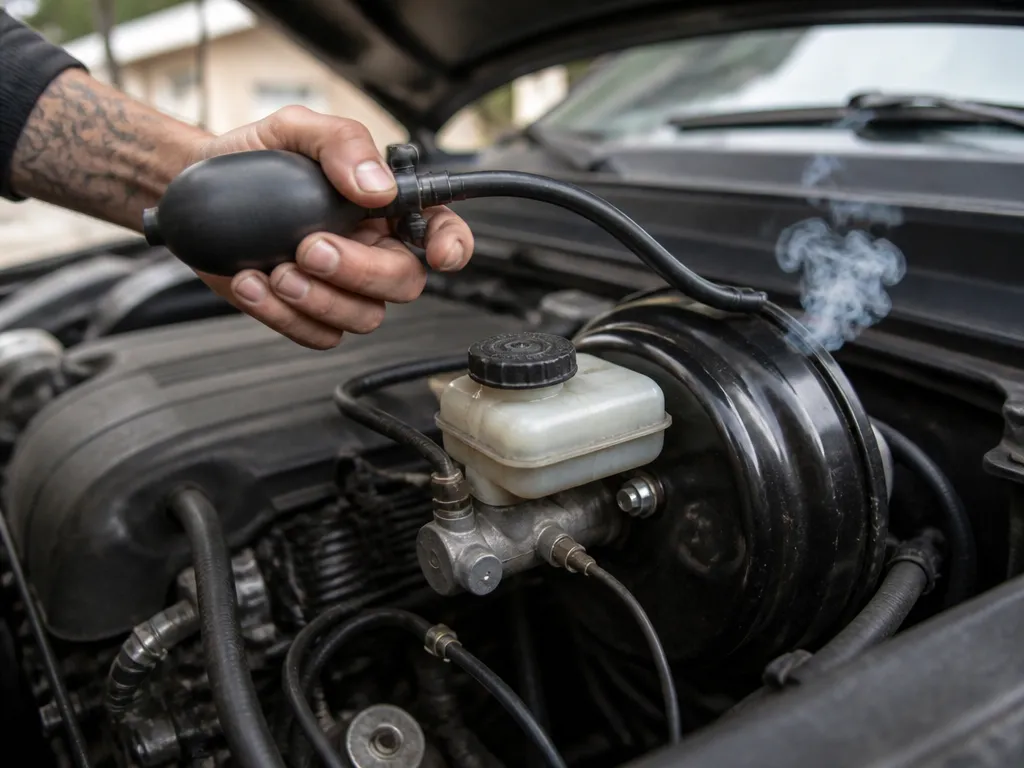
Can You Smoke Test A Brake Booster For Vacuum Leaks?
You can smoke-test a vacuum-assisted brake booster for leaks in its vacuum circuit. The test can help distinguish a leaking hose, fitting, check valve, or booster inlet from a leak-free external circuit. It does not test hydraulic brake faults, and it may not reveal every internal booster failure.
Smoke testing makes the most sense when the symptoms suggest reduced vacuum assist, such as a hard pedal, and you can isolate the booster circuit. Connect the smoke source at the booster vacuum inlet, seal unintended branches, and watch for smoke escaping from a sealed joint or booster surface. If the result is unclear, use a vacuum gauge and controlled pedal checks instead of repeatedly changing the smoke-test setup.
Can A Smoke Test Determine A Brake Booster Vacuum Leak?
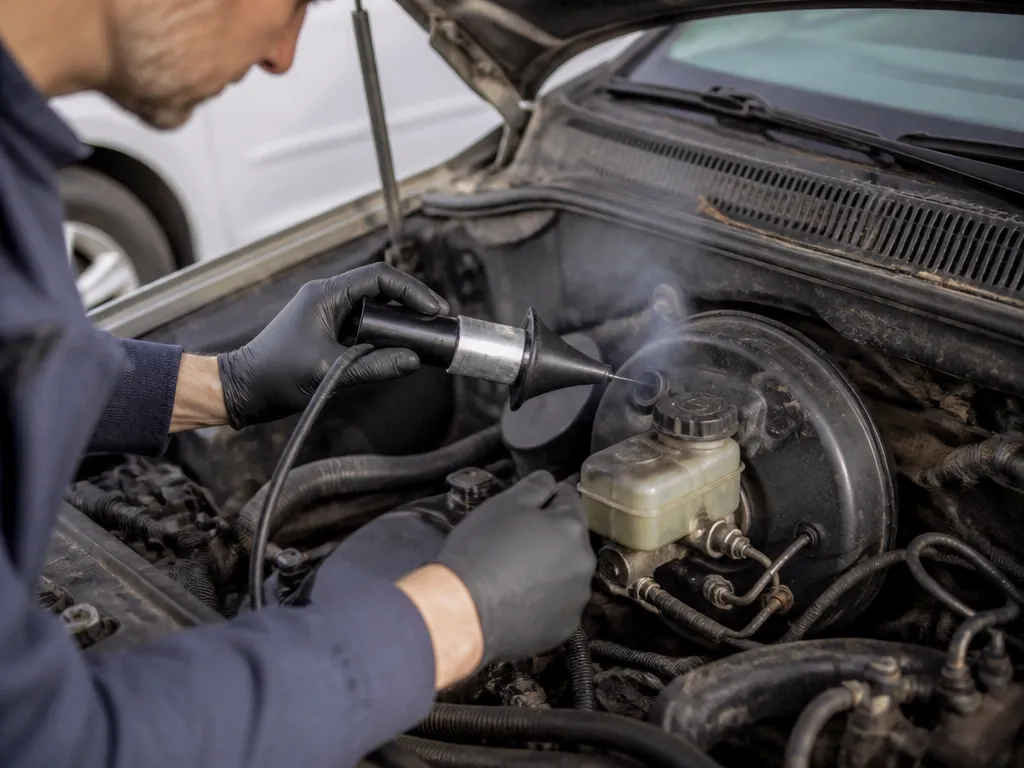
Yes, a smoke test can help locate a leak in the vacuum circuit connected to a brake booster. It is most useful for the supply hose, fittings, check valve, booster inlet seal, and any externally accessible booster surface that should remain sealed.
What The Test Is Meant To Reveal (And When It Is Decisive)
When smoke is introduced at the booster vacuum inlet, it should remain within the sealed vacuum path. Smoke escaping from a hose, joint, valve connection, inlet seal, or other sealed surface identifies a leak at or near that point, provided the test equipment and all temporary seals are tight.
What The Test Cannot Reliably Diagnose
A smoke test does not prove that the booster’s internal valve, diaphragm, or mechanical parts work correctly. An internal fault may not create a clearly visible external smoke escape. Smoke can also travel through internal or unintended passages and emerge somewhere other than the actual fault.
Use smoke testing to find an external escape in the booster vacuum path. A clean result only applies to the section that was properly connected and sealed. It does not by itself prove that the booster or the hydraulic brake system is healthy.
How Does Smoke Testing Work For A Vacuum Brake System?
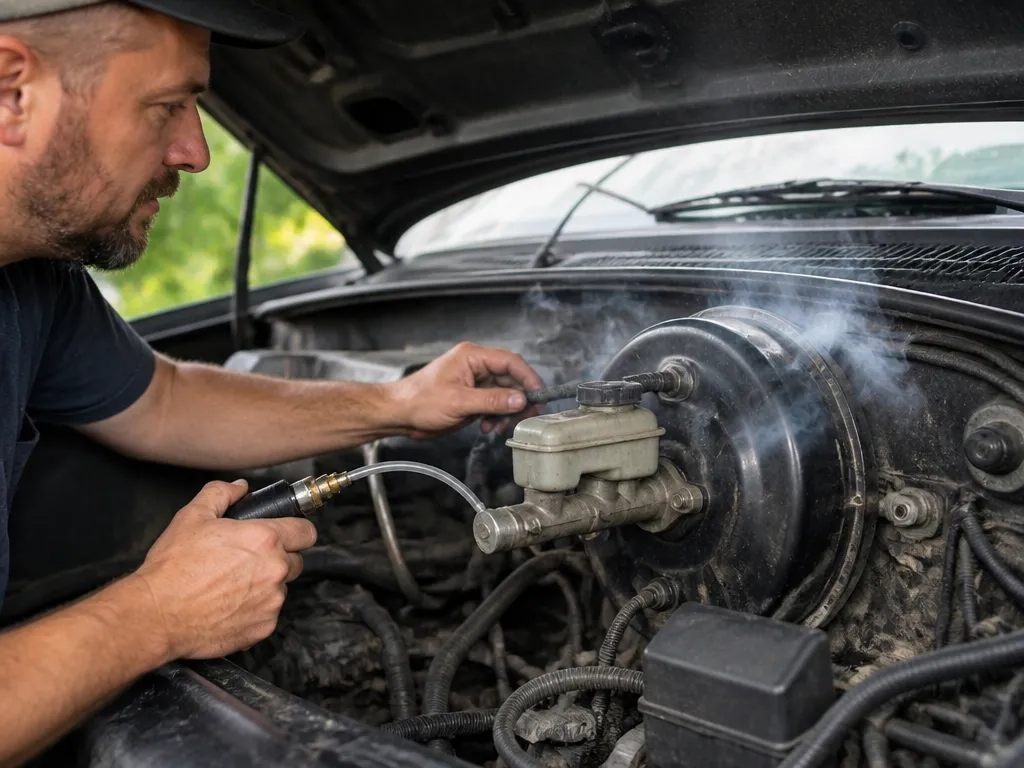
A smoke machine sends visible vapor into an isolated vacuum circuit. The smoke makes an unintended opening easier to see. For a brake booster, the useful result comes from tracing the circuit that supplies vacuum assist while preventing smoke from escaping through unrelated branches.
The most common setup error is sealing the wrong points. A misplaced cap can block the suspected leak, divert smoke into another vacuum circuit, or create an opening that did not exist before the test.
Where Should You Connect And Seal For Accurate Results?
Connect the smoke source at the booster’s vacuum inlet, then control every other route connected to that section. The exact connection depends on the vehicle’s hose layout, but the objective is the same: test the booster-side circuit without leaving an unintended path open.
Trace the hose routing before connecting the smoke machine. Look for loose clamps, cracked connectors, damaged rubber, and nearby vacuum takeoffs. If the goal is to inspect the booster inlet or shell, smoke must be forced through that area rather than allowed to escape through a parallel branch.
Use caps and plugs that fit the actual fittings. A poor-fitting adapter can create a leak at the test equipment and make a sound booster appear faulty. An open reservoir or auxiliary line can do the same by providing smoke with an easier route.
Practical rule: use one controlled smoke entry point and seal every branch outside the intended test section. If you cannot identify the circuit boundaries, consider the result preliminary and use a vacuum-hold test to confirm it.
What Engine State Is Recommended During The Test And Why?
Keep the engine off while introducing smoke. A running engine creates vacuum and moves air through the circuit, which can draw smoke away from a small leak. With the engine stopped, the smoke machine controls the test conditions more consistently.
For a conventional vacuum booster, the ignition usually does not need to be on. If the vehicle has an electric vacuum pump or electronically controlled vacuum equipment, follow the vehicle-specific procedure and prevent the pump from changing the test conditions unless the pump itself is being tested.
Vehicles With A Reservoir Or Electric Vacuum Pump
A reservoir adds volume and another possible smoke route. An electric pump can alter pressure or remove smoke as it operates. Identify these components before testing and isolate them according to the vehicle’s service procedure when the aim is to test only the booster circuit.
Some vehicles use engine vacuum, some use a reservoir, and others rely partly or entirely on an electric pump. If the pump cannot remain inactive, test the booster circuit separately from the pump and reservoir where possible. A vehicle without a conventional vacuum booster needs a different diagnostic method, so do not assume that this procedure applies to every electronically assisted brake system.
How Do You Read Smoke Behavior At Each Test Point?
Follow the first visible escape point. Smoke can travel through a hose or inside a component before becoming visible, so the place where smoke accumulates is not necessarily the source.
What Does A Successful Test Look Like For A Healthy Booster?

During a properly bounded test, no smoke should escape from the booster shell, its sealed vacuum inlet, the included hose connections, or the check-valve connections. Smoke may fill the intended circuit without appearing at an unintended opening.
Do not confuse smoke remaining inside the test circuit with smoke steadily emerging from a sealed joint. Some test setups may include a normal vent or open passage, depending on the vehicle and the section isolated. Smoke at that known outlet does not automatically indicate a failed booster.
A pass means that no visible external escape was found under the conditions of that test. It does not prove that the booster’s internal valve works, that it produces the expected assistance, or that the hydraulic brake system is sound.
After testing, remove the equipment and restore every hose, check valve, reservoir connection, and electrical connection. Recheck the joints, then perform the vehicle’s normal brake-assist checks while stationary and in a safe location. If the symptom remains, move to vacuum retention, pedal-assist, and hydraulic checks.
What Are The Main Limitations And False Positives?
Smoke results are only as reliable as the test boundary. Air or smoke can use any route that was left open, and contamination or a poor adapter can look like a vehicle-side leak.
If Smoke Testing Isn’t Conclusive, What’s The Fallback Path?
Use a vacuum gauge, a vacuum-retention check, a controlled pedal check, and a visual inspection. This sequence is more useful than repeating a smoke test with uncertain connections.
What Safety Cautions Should You Follow During The Test?
Work with the engine off, good ventilation, and only the pressure recommended by the smoke-machine instructions. Do not improvise adapters or force compressed shop air into a brake-booster vacuum circuit.
Keep the smoke machine away from hot components, ignition sources, and spilled fluids. Allow recently operated parts to cool, secure loose clothing and tools, and keep the vehicle stationary with the parking brake applied. Ventilate the area and stop if smoke irritates your eyes or breathing or reduces visibility.
A vacuum leak and a brake-fluid leak produce different evidence. A vacuum fault involves air movement, poor vacuum retention, or smoke escaping from the booster path. Hydraulic leakage leaves fluid around the master cylinder, brake lines, hose connections, calipers, or wheel cylinders and may lower the reservoir level. Fluid on a component does not prove that the booster has failed. Trace the wet path to its highest point.
If brake fluid is visibly leaking, the pedal is unusually soft, or the reservoir level is falling, stop the smoke diagnosis and have the hydraulic system inspected before driving. A smoke test cannot prove that hydraulic pressure, seals, or friction components are safe.
Quick Summary
You can smoke-test a vacuum-assisted brake booster for external leaks in its vacuum path. The test does not reliably diagnose hydraulic faults or every internal booster failure.
Conditions that change the answer (and the value of the result):
Next action: If the smoke result is inconclusive, perform a vacuum-retention test and controlled pedal checks. Use those results to distinguish a hose or check-valve repair from a possible booster replacement.
Frequently Asked Questions
How Much Does It Cost To Smoke-test A Brake Booster?
No reliable pricing figure is available here. The cost depends on shop labor, the equipment used, vehicle access, and whether the shop includes the test in a wider brake diagnosis. DIY cost depends on whether you rent or buy a smoke machine and the required adapters.
When calling a shop, ask: “Can you smoke-test the booster vacuum circuit and check the vacuum check valve and booster inlet area?” That keeps the quote tied to the diagnostic scope you need.
How Long Does The Test Usually Take, Assuming The Connections Are Accessible?
No dependable timing benchmark applies to every vehicle. The work may take longer when the booster is difficult to access, several components share the circuit, or the branches must be sealed individually.
Allow additional time for setup and cleanup. Rushed sealing and incorrect connection points are common reasons for an inconclusive result.
Can I Smoke-test Even If My Symptoms Are Intermittent?
Yes, but a static smoke test may miss a leak that appears only with temperature changes, engine movement, load changes, or another operating condition. A clean result does not rule out an intermittent fault.
If the symptom continues, use vacuum-retention and controlled pedal checks while observing the conditions that trigger the problem.
What Happens If I Keep Driving With A Suspected Booster Vacuum Leak?
There is no universal safe driving period. A vacuum fault can reduce or change brake assist, increasing pedal effort or making braking feel inconsistent.
If the pedal becomes hard, assist is delayed, or braking effort changes suddenly, stop driving and arrange an inspection. Do not use continued driving as a substitute for diagnosis.
When Should I Stop Diy Troubleshooting And Get Professional Help?
Get professional help when you cannot identify the vacuum boundaries, maintain sealed connections, or distinguish a booster leak from a hose or check-valve leak. An uncertain smoke result can waste time and lead to unnecessary parts replacement.
Also seek help when you find fluid contamination, wiring or sensor concerns, a soft or sinking pedal, or any fault that may involve more than the vacuum circuit.
How Can I Verify A Shop’s Smoke-test Claim At Home Without Repeating Everything?
Ask the shop which exact escape point they observed and how they prevented bypass routes. A useful report should identify a hose or fitting, the check-valve area, the booster inlet, or an accessible booster surface and should explain how other branches were isolated.
If the shop says the booster is faulty, ask whether it also checked vacuum retention and separated the booster from the hose and check valve. Without that separation, the smoke finding is less conclusive.